

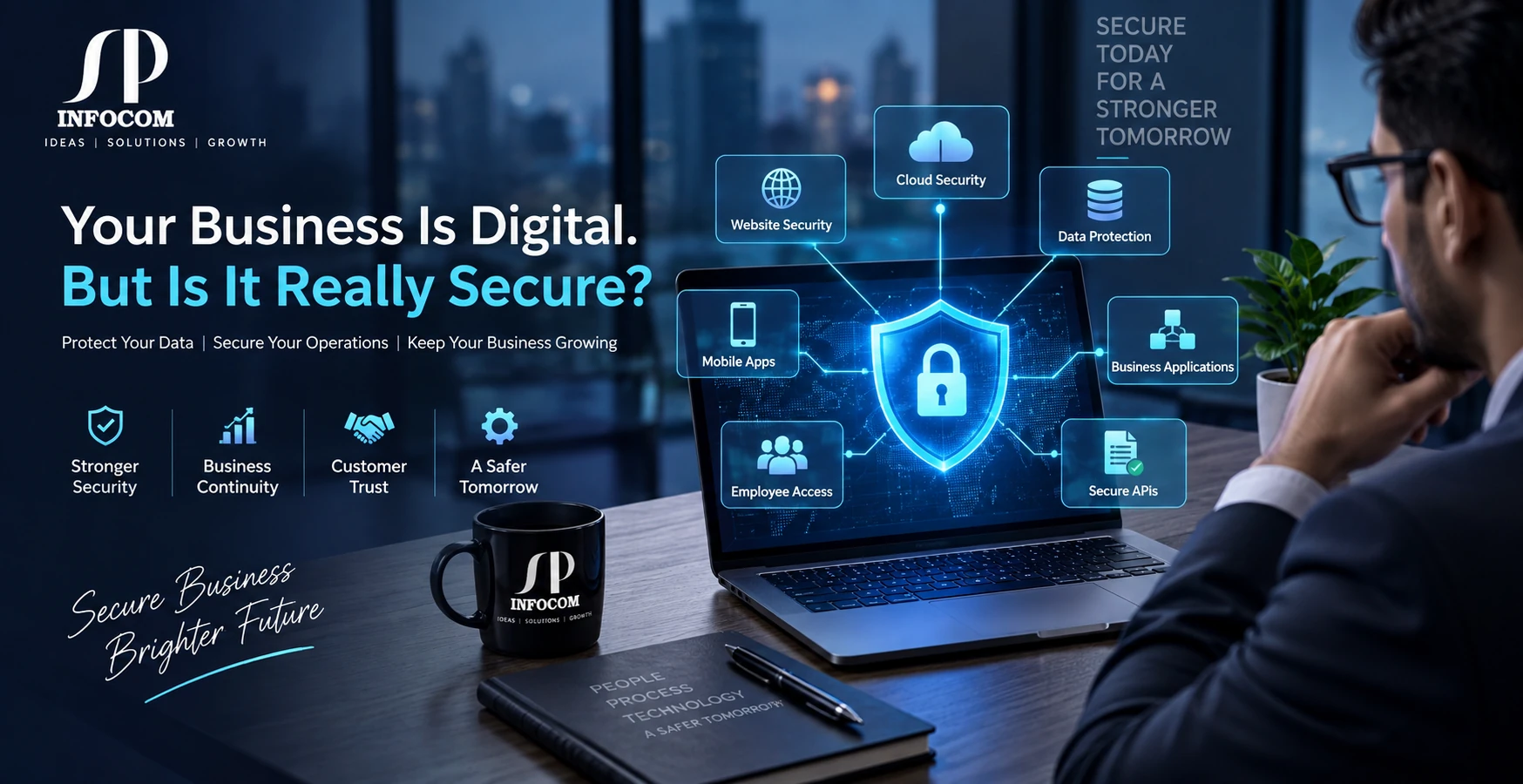
Businesses today depend on technology for almost every part of their operations. Websites, mobile applications, cloud platforms, ERP systems, CRM software, payment systems, employee portals, and online communication have become essential tools for modern organizations.
But as businesses become more digital, the amount of valuable information stored and exchanged through these systems also increases. Customer information, employee records, financial data, business documents, login credentials, and operational information all need to be protected.
This raises an important question:
Your business may be digital. But is it really secure?
Why Cybersecurity Matters for Every Business
Cybersecurity is no longer something that only large enterprises need to think about. Businesses of every size can face security risks when their websites, applications, databases, cloud services, or employee accounts are not properly protected.
A security incident can affect much more than an IT system. It can interrupt operations, expose sensitive information, affect customer trust, and create financial and operational challenges.
That is why security should be considered during software development, system integration, cloud deployment, and everyday business operations.
1. Your Website Is Part of Your Security Environment
A business website is often the first digital point of contact between a company and its customers. Many websites also contain enquiry forms, customer information, login systems, payment functionality, APIs, and connections to other business applications.
Security should therefore be considered beyond simply installing an SSL certificate. Businesses should also pay attention to secure authentication, software updates, access controls, secure APIs, database protection, backups, and server configuration.
- Secure authentication and login systems
- HTTPS and secure communication
- Secure API development
- Regular software updates
- Database protection
2. Customer Data Needs Strong Protection
Customer data is one of the most important assets handled by modern businesses. Depending on the industry, this may include names, contact information, addresses, transaction records, account details, documents, or other sensitive information.
Businesses should understand what information they collect, where it is stored, who can access it, and how it moves between different systems.
Strong access controls and appropriate security practices can help reduce unnecessary exposure of sensitive business and customer information.
3. Employee Accounts Can Become a Security Risk
Employees regularly access business applications, email accounts, cloud services, databases, and internal systems. If user accounts are not properly managed, unauthorized access can become easier.
Businesses should follow the principle of giving employees only the access they actually need to perform their responsibilities.
- Role-based access control
- Strong passwords
- Multi-factor authentication
- Regular access reviews
- Removal of inactive accounts
4. Your Cloud Systems Need Security Too
Cloud technology has made it easier for businesses to access applications and data from different locations. However, moving systems to the cloud does not automatically make them secure.
Cloud environments should be configured carefully, with appropriate permissions, authentication, monitoring, backups, and data protection practices.
Businesses should also regularly review which users and applications have access to their cloud resources.
5. APIs Connect Your Systems — and Need Protection
Modern business software rarely works in isolation. Websites, mobile apps, ERP systems, CRM platforms, payment gateways, accounting applications, and third-party services often communicate through APIs.
APIs make integration possible, but they also need appropriate authentication, authorization, validation, rate limiting, logging, and secure data handling.
A secure integration strategy helps businesses connect systems without unnecessarily exposing sensitive information.
6. Regular Backups Can Help Your Business Recover
Security is not only about preventing unauthorized access. Businesses also need to prepare for situations where data becomes unavailable, corrupted, deleted, or affected by a security incident.
Regular and properly managed backups can provide an important recovery option. Businesses should determine which data is critical, how frequently it should be backed up, and how backups will be restored when needed.
- Regular database backups
- Secure backup storage
- Backup monitoring
- Recovery testing
- Disaster recovery planning
7. Software Updates Should Not Be Ignored
Business software depends on operating systems, frameworks, libraries, plugins, databases, servers, and other components. Over time, updates may be released to improve functionality, stability, or security.
Running outdated components can increase maintenance and security risks. Businesses should maintain an inventory of important software components and follow a controlled update process.
8. Security Should Be Built Into Software Development
Security should not be treated as something added at the end of a software project. It is more effective to consider security throughout the development lifecycle.
Requirements, architecture, coding, testing, deployment, and maintenance can all include security considerations.
For custom software projects, businesses can discuss security requirements with their development partner from the beginning rather than treating security as a final checklist item.
9. AI Is Creating New Security Considerations
Artificial intelligence is increasingly being used in business applications, customer service, software development, analytics, and automation. While AI can provide valuable capabilities, businesses also need to understand how AI systems handle business information.
Before connecting AI tools to business systems, organizations should consider what data is being shared, who can access the information, how the integration works, and what security controls are required.
10. Security Awareness Is a Business Responsibility
Technology alone cannot protect every business system. Employees also play an important role in maintaining security.
Regular awareness and clear internal procedures can help employees recognize suspicious emails, protect credentials, handle sensitive information carefully, and report unusual activity.
Security becomes stronger when technology, processes, and people work together.
How Can a Business Improve Its Security?
Businesses do not need to change everything at once. A practical approach is to first understand the systems and information that are most important to daily operations.
Start by reviewing your websites, applications, databases, cloud platforms, user accounts, APIs, backups, and third-party integrations.
- Identify critical business data and systems
- Review user access and permissions
- Secure websites and APIs
- Enable appropriate authentication controls
- Maintain reliable backups
- Keep software and infrastructure updated
- Review third-party integrations
- Train employees on basic security practices
- Create an incident response and recovery plan
Security Should Grow With Your Business
A small business may begin with a website, email accounts, and a few cloud applications. As the organization grows, it may introduce ERP software, CRM systems, mobile applications, payment integrations, employee portals, APIs, and multiple cloud services.
Each new system can introduce additional connections and access points. Security therefore needs to evolve along with the technology environment.
Building security into technology decisions from the beginning can make it easier to manage the growing digital environment later.
Final Thoughts
Digital technology has changed the way businesses operate, communicate, sell, and serve customers. But becoming digital also means taking responsibility for protecting the systems and information that make those operations possible.
Cybersecurity should not be considered only an IT responsibility. Business owners, management teams, employees, developers, system administrators, and technology partners all have a role to play.
The right security approach depends on the size of the organization, the type of data it handles, its technology environment, and its specific business requirements.
At SP Infocom, we help businesses design and develop secure, scalable technology solutions across websites, mobile applications, custom software, ERP, CRM, cloud systems, and business applications. Security considerations can be incorporated into the architecture, development, integration, and deployment of solutions according to business requirements.