

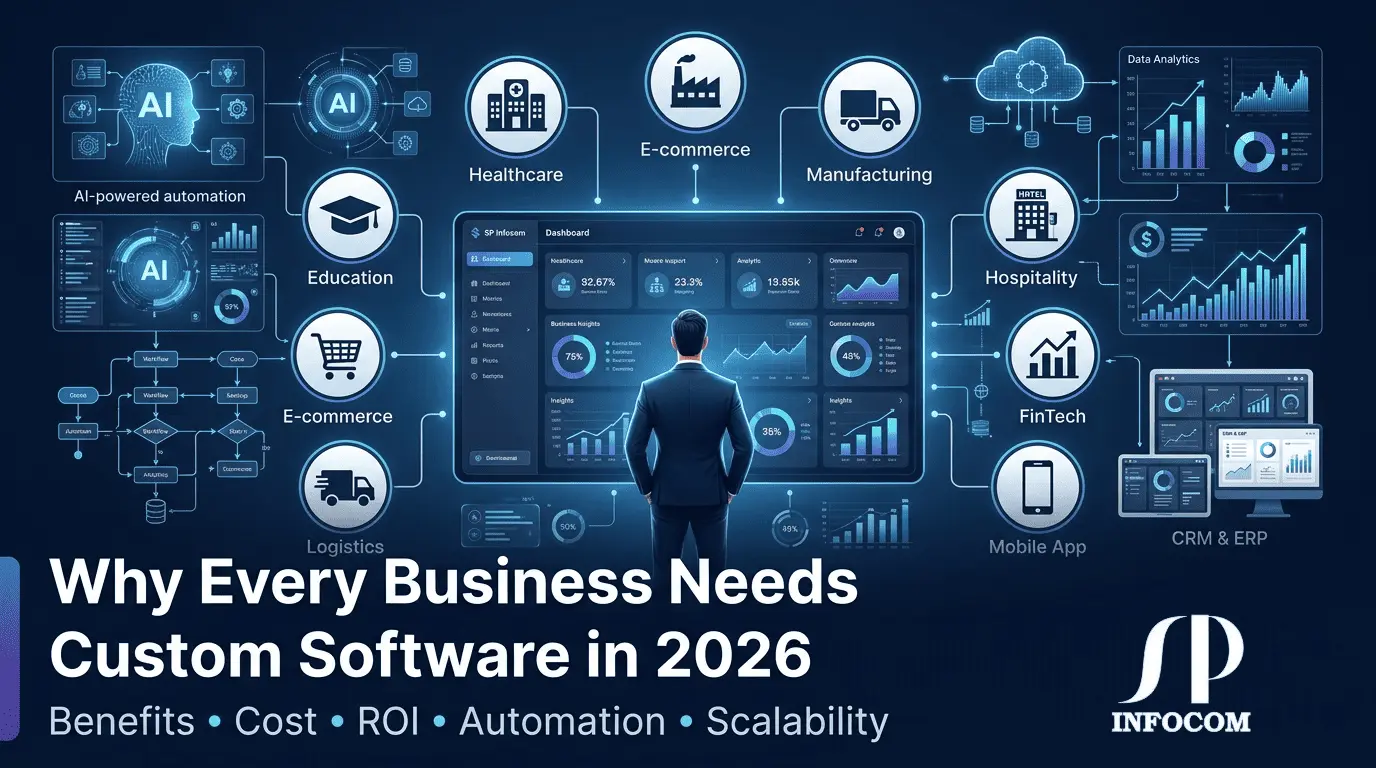
In today's rapidly evolving digital landscape, businesses can no longer depend on spreadsheets, disconnected applications, and manual processes to manage their operations. As customer expectations rise and competition intensifies, organizations need smarter, faster, and more scalable solutions to stay ahead.
This is why businesses across industries are increasingly investing in custom software development.
From healthcare and education to manufacturing, real estate, e-commerce, logistics, hospitality, and fintech, organizations are embracing tailored technology solutions to improve efficiency, reduce costs, and accelerate growth.
In this guide, we'll explore why custom software has become a necessity in 2026, its key benefits, estimated costs, and how businesses can measure their return on investment (ROI).
What is Custom Software?
Custom software is a solution specifically designed and developed to meet the unique needs of a business.
Unlike off-the-shelf software, which is built for a broad audience, custom software is tailored to your organization's workflows, processes, and long-term objectives.
Examples of custom software include:
- Enterprise Resource Planning (ERP) Systems
- Customer Relationship Management (CRM) Software
- Hospital Management Systems
- School and College Management Systems
- MLM & Direct Selling Software
- Hotel Management Systems
- Real Estate Management Platforms
- Logistics & Fleet Management Solutions
- E-commerce Platforms
- FinTech Applications
- Mobile Applications
- Employee Portals and HR Management Systems
The biggest advantage is simple:
Your software is built around your business—not the other way around.
Why Generic Tools Are No Longer Enough
Many businesses start with multiple third-party tools to manage different operations.
For example:
- One tool for accounting
- Another for customer management
- A separate system for inventory
- Excel sheets for reporting
- WhatsApp for communication
- Multiple subscriptions for daily operations
Initially, this setup may work, but as businesses grow, these disconnected systems create several challenges:
- Duplicate data entry
- Increased operational errors
- Lack of real-time visibility
- Data silos between departments
- Poor collaboration
- Higher subscription costs
- Limited scalability
Custom software solves these issues by creating a centralized digital ecosystem.
Why Businesses Need Custom Software in 2026
1. Digital Transformation Is No Longer Optional
Businesses that embrace technology are outperforming competitors in efficiency, customer experience, and profitability.
Digital transformation is no longer limited to large enterprises. Small and medium-sized businesses are also investing in technology to streamline operations and remain competitive.
Custom software enables organizations to digitize and automate their core business processes.
2. Every Business Has Unique Requirements
No two businesses operate exactly the same way.
A manufacturing company has different operational needs than a hospital, while an e-commerce business requires completely different workflows than a real estate company.
Custom software adapts to your business instead of forcing your business to adapt to generic software.
3. Increased Productivity Through Automation
Employees often spend hours performing repetitive tasks every day. Custom software can automate:
- Data entry
- Invoice generation
- Appointment scheduling
- Lead management
- Employee attendance
- Report generation
- Payment tracking
- Customer communication
- Inventory management
Automation reduces manual work and allows teams to focus on business growth.
4. Better Data Security
Data is one of the most valuable assets of any business. Cybersecurity threats continue to grow, making data protection a top priority.
Custom software can include advanced security features such as:
- Role-based access control
- Data encryption
- Multi-factor authentication
- Audit logs
- Secure cloud backups
- User activity monitoring
5. Seamless Integration With Existing Systems
Businesses often rely on multiple platforms and third-party tools.
Custom software can integrate seamlessly with:
- Accounting systems
- Payment gateways
- SMS services
- Email platforms
- HR systems
- ERP solutions
- CRM platforms
- Third-party APIs
This creates a unified ecosystem where information flows smoothly across departments.
6. Scalability for Future Growth
Your business today will not be the same in three or five years.
As your organization expands, your software should grow with you.
- Additional users
- Multiple branches
- New services
- Multiple locations
- International expansion
- New business models
Industries Benefiting From Custom Software in 2026
Custom software is transforming businesses across various industries, including:
- Healthcare & Hospital Management
- Education & E-Learning
- E-Commerce & Retail
- Direct Selling & MLM
- Hospitality & Tourism
- Logistics & Supply Chain
- Real Estate & Property Management
- Manufacturing
- FinTech & Investment Services
Custom Software vs Off-the-Shelf Software
| Feature | Off-the-Shelf Software | Custom Software |
|---|---|---|
| Customization | Limited | Fully Customizable |
| Scalability | Moderate | High |
| Integration | Limited | Extensive |
| Security | Standard | Enhanced |
| Ownership | No | Yes |
| Long-Term ROI | Moderate | High |
How Much Does Custom Software Cost in 2026?
Software development costs vary depending on complexity, features, integrations, and project scope.
- Basic Business Software: ₹50,000 - ₹2,00,000
- Medium Complexity Software: ₹1,50,000 - ₹4,00,000
- Enterprise-Level Software: ₹5,00,000 - ₹15,00,000+
- Mobile Applications: ₹1,50,000 - ₹10,00,000+
How Much Does Custom Software Cost in 2026?
The cost of custom software development depends on factors such as project complexity, features, integrations, number of users, and future scalability requirements.
Here are some estimated price ranges for businesses in India:
These are estimated figures and can vary depending on business requirements, third-party integrations, security requirements, and project timelines.
Instead of viewing software as an expense, businesses should consider it a long-term investment that improves efficiency, reduces operational costs, and drives business growth.
Instead of viewing software as an expense, businesses should consider it a long-term investment.
Understanding ROI (Return on Investment)
Many businesses ask a common question:
Will custom software pay for itself?
In most cases, the answer is yes.
ROI = (Financial Gain - Software Cost) ÷ Software Cost × 100
Final Thoughts
In 2026, custom software is no longer a luxury—it's a strategic business necessity.
Organizations that invest in tailored technology solutions gain significant advantages through automation, operational efficiency, stronger security, improved customer experiences, and long-term cost savings.
The right technology doesn't just solve today's challenges—it builds the foundation for tomorrow's success.
At SP Infocom, we help businesses across multiple industries build scalable, secure, and future-ready software solutions that accelerate digital transformation.